
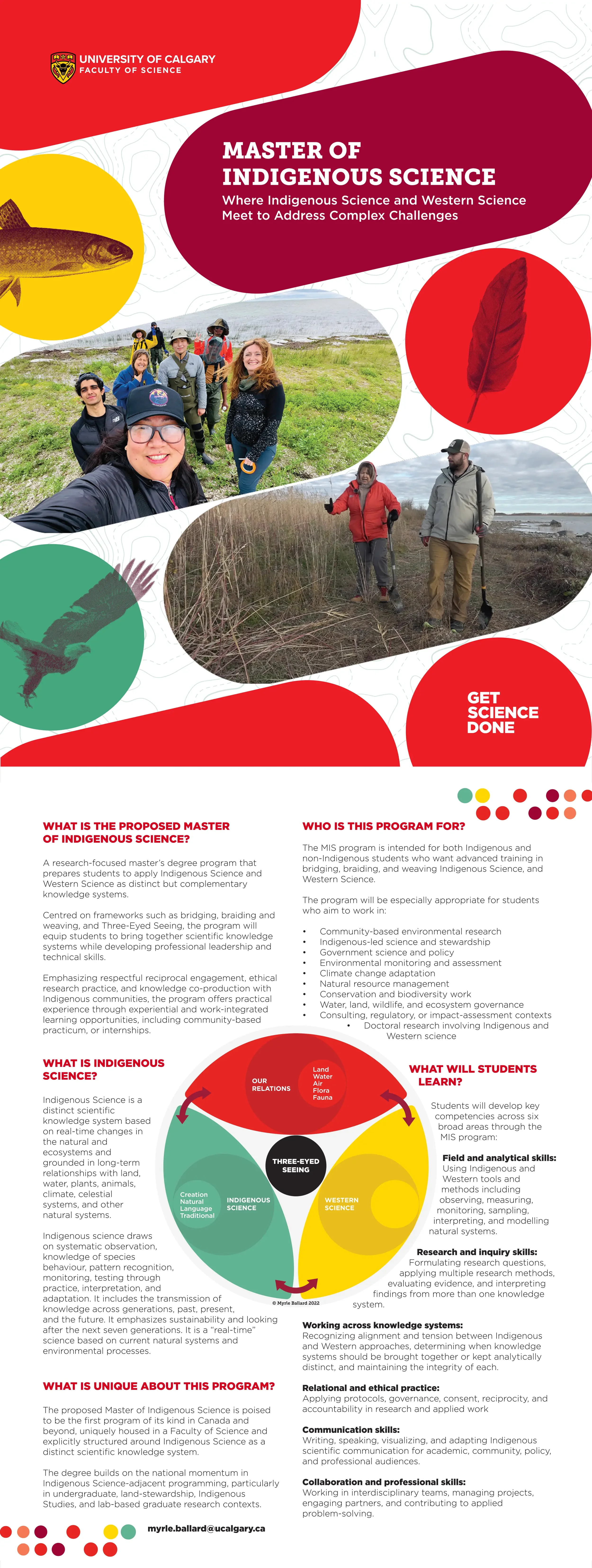
Master of Indigenous Science
Where Indigenous Science and Western Science Meet to Address Complex Challenges
What is the proposed Master of Indigenous Science?
A research-focused master’s degree program that prepares students to apply Indigenous Science and Western Science as distinct but complementary knowledge systems.
Centred on frameworks such as bridging, braiding and weaving, and Three-Eyed Seeing, the program will equip students to bring together scientific knowledge systems while developing professional leadership and technical skills.
Emphasizing respectful reciprocal engagement, ethical research practice, and knowledge co-production with Indigenous communities, the program offers practical experience through experiential and work-integrated learning opportunities, including community-based practicum or internships.
What is Indigenous Science?
Indigenous Science is a distinct scientific knowledge system based on real-time changes in the natural and ecosystems and grounded in long-term relationships with land, water, plants, animals, climate, celestial systems, and other natural systems.
Indigenous science draws on systematic observation, knowledge of species behaviour, pattern recognition, monitoring, testing through practice, interpretation, and adaptation. It includes the transmission of knowledge across generations, past, present, and the future. It emphasizes sustainability and looking after the next seven generations. It is a “real-time” science based on current natural systems and environmental processes.

What is unique about this program?
The proposed Master of Indigenous Science is poised to be the first program of its kind in Canada and beyond, uniquely housed in a Faculty of Science and explicitly structured around Indigenous Science as a distinct scientific knowledge system.
The degree builds on the national momentum in Indigenous Science-adjacent programming, particularly in undergraduate, land-stewardship, Indigenous Studies, and lab-based graduate research contexts.
Who is this program for?
The MIS program is intended for both Indigenous and non-Indigenous students who want advanced training in bridging, braiding and weaving Indigenous Science and Western Science.
The program will be especially appropriate for students who aim to work in:
Community-based environmental research
Indigenous-led science and stewardship
Government science and policy
Environmental monitoring and assessment
Climate change adaptation
Natural resource management
Conservation and biodiversity work
Water, land, wildlife, and ecosystem governance
Consulting, regulatory, or impact-assessment contexts
Doctoral research involving Indigenous and Western science
Click image to download PDF
What will students learn?
Students will develop key competencies across six broad areas through the MIS program:
Field and analytical skills:
Using Indigenous and Western tools and methods including observing, measuring, monitoring, sampling, interpreting, and modelling natural systems.
Research and inquiry skills:
Formulating research questions, applying multiple research methods, evaluating evidence, and interpreting findings from more than one knowledge system.
Working across knowledge systems:
Recognizing alignment and tension between Indigenous and Western approaches, determining when knowledge systems should be brought together or kept analytically distinct, and maintaining the integrity of each.
Relational and ethical practice:
Applying protocols, governance, consent, reciprocity, and accountability in research and applied work
Communication skills:
Writing, speaking, visualizing, and adapting Indigenous scientific communication for academic, community, policy, and professional audiences.
Collaboration and professional skills:
Working in interdisciplinary teams, managing projects, engaging partners, and contributing to applied problem-solving.